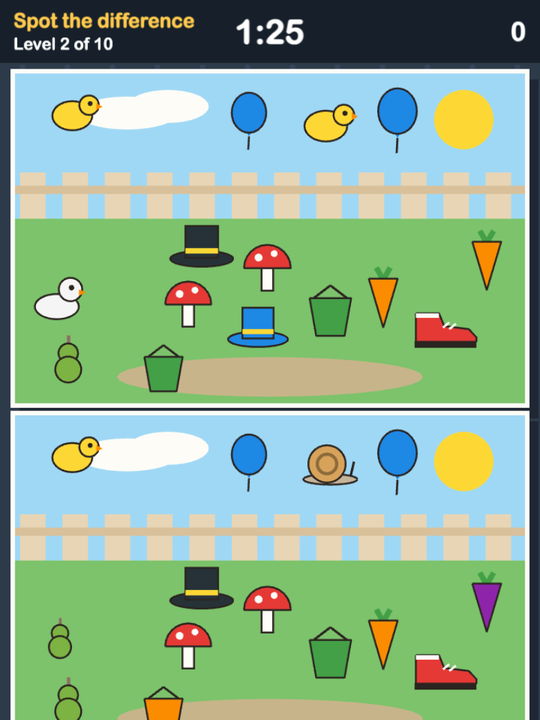
Browser game example

FIND IT!: SPOT THE DIFFERENCE AND HIDDEN OBJECTS

Find It! puts two classic puzzles behind one start screen. In Spot the difference you get two copies of the same scene with five changes between them: a thing in a new colour, a thing missing, a thing swapped for another, a thing grown or shrunk, a thing moved along. Tap a change on either picture and both get a green ring. On a computer the pictures sit side by side; on an upright phone one sits above the other.

In Hidden objects you get one busy scene and a list of named things to find, each in the picture exactly once. A countdown runs in both games, a tap on nothing costs five seconds, and a hint rings one thing for ten seconds. Every picture is drawn by the game itself from simple shapes, in six scenes from a living room to a beach, so no two levels look alike.

Cleo is opening to founders in small batches. Join the waitlist and we'll save your spot.

Updated

A real screenshot of Find It!: Spot the Difference and Hidden Objects

WHAT THIS EXAMPLE SHOWS

Two looking-closely games in one: spot the five differences between two pictures, or find every thing on a list hidden in one busy picture, before the clock runs out. Use the sample to name the audience, the main action, and the smallest useful first version. Cleo HQ then helps turn your own brief into a product plan and a working build.

QUESTIONS FOUNDERS ASK

Which game ideas does it fit?

Ideas built on looking closely at a picture: a spot the difference game with five changes a level, a hidden object game with a list and a timer, an I spy or seek-and-find game for children, or a where-is-the-cat game in a messy room. It is a good start for a branded puzzle for a shop or a classroom too.

Is every level fair to play on a phone?

Yes. Every place you can tap is at least the size of a fingertip on a phone held either way up, no two of them overlap, and a thing on the hidden list is never more than slightly covered by anything else. Each level is checked by the game before it is shown, so it can always be finished in the time given.

How does it get harder?

Each game has ten levels. Later levels put more things in the picture, give a little less time and, in spot the difference, add the harder changes: a thing that grew, shrank or moved. A kids setting stops the clock altogether, so a mistake or a hint never costs anything, and a challenge link gives a friend the very same picture.