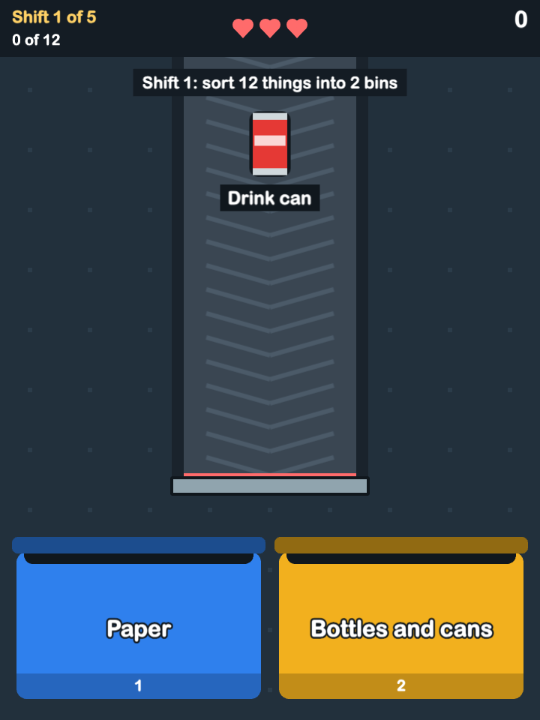
Browser game example

SORTING RUSH: CONVEYOR BELT SORTING GAME

Sorting Rush is a game about putting things where they belong, quickly. One thing at a time rides down a conveyor belt toward a row of bins. On a phone you flick toward a bin or tap it; on a computer you use the arrow keys and Space, the number keys or the mouse. A right answer scores, and a run of right answers scores more.

A wrong bin or a piece that falls off the end costs one of three lives, and the game shows where it should have gone. There are five shifts to finish, each faster than the last, with a third and then a fourth bin opening along the way. An endless mode keeps going until the lives run out and remembers your best score.

Cleo is opening to founders in small batches. Join the waitlist and we'll save your spot.

Updated

A real screenshot of Sorting Rush: Conveyor Belt Sorting Game

WHAT THIS EXAMPLE SHOWS

Rubbish rides down a conveyor belt and you flick each piece into the right bin before it falls off the end. The belt speeds up and more bins open. Use the sample to name the audience, the main action, and the smallest useful first version. Cleo HQ then helps turn your own brief into a product plan and a working build.

QUESTIONS FOUNDERS ASK

Which game ideas does it fit?

Ideas where things arrive one at a time and each has a right place: sorting the recycling, the post into pigeonholes, fruit by colour, laundry into baskets, luggage onto the right flight, or healthy and junk food. The bins and what goes in them are one list, so the theme changes without changing how it plays.

Can a teacher use it in class?

Yes. A thing on the belt can be a word on a card instead of a picture, so the same game sorts words into nouns and verbs, numbers into odd and even, or animals into groups. A kids setting slows the belt down and never takes a life, and every mistake shows which bin was the right one.

How does it get harder?

The belt gets a little quicker with every piece and a lot quicker with every shift, and extra bins open so there is more to choose between. It never gets faster than a person can read and react, because a piece always stays on the belt for more than a second, however long you last.