Web app example · a beginner stargazer, teacher or curious learner

ASTRONOMY EXPLORER WITH AN INTERACTIVE SKY MAP

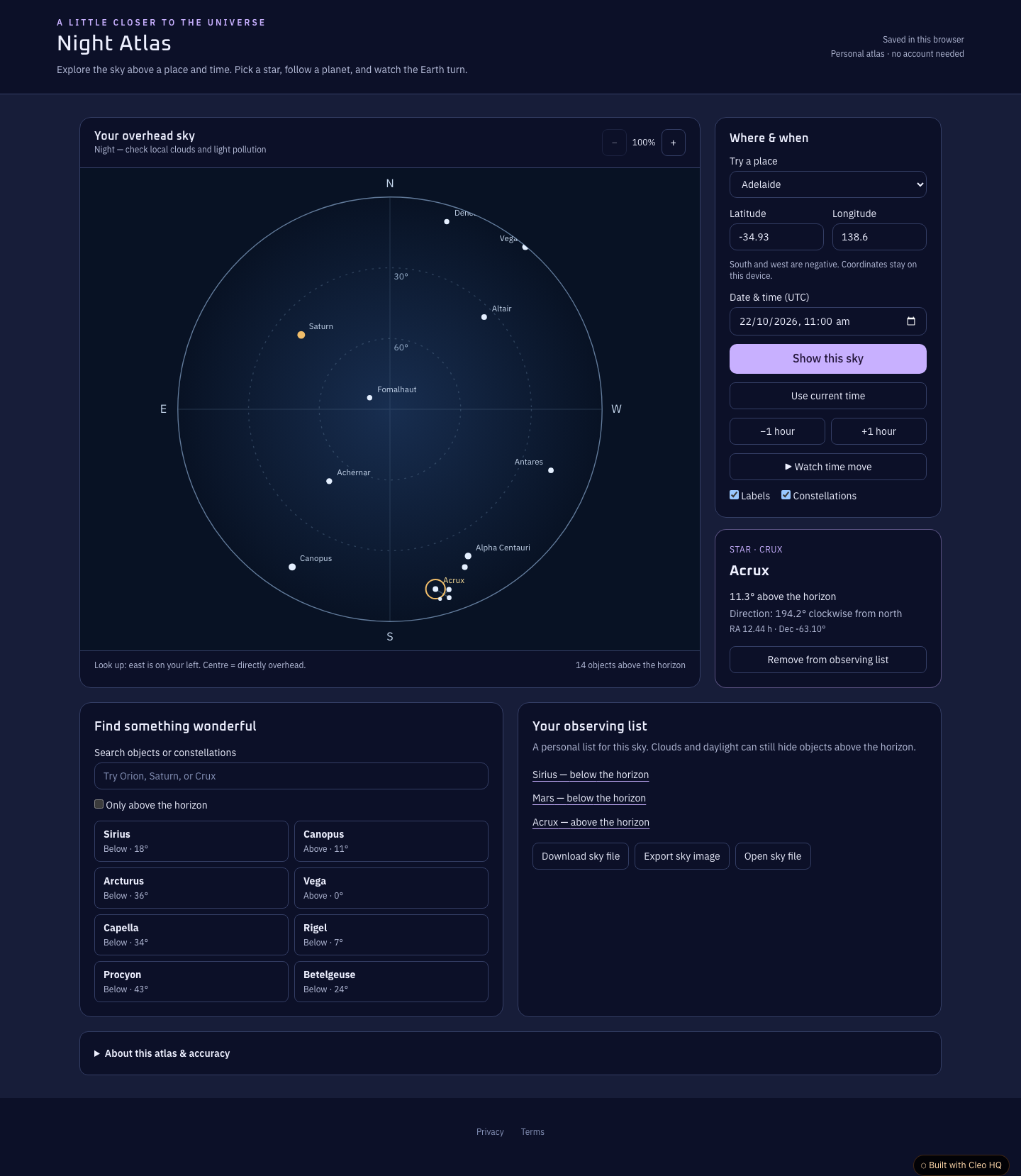
See how the sky changes with your place and time. The astronomy explorer plots a curated set of bright stars, constellation outlines, the Sun and five planets on an overhead chart, with a visible horizon and controls for stepping through time.

Search for an object to see its direction and height above the horizon, then add it to a personal observing list. The atlas explains its approximate calculations and catalogue limits. It is an educational explorer rather than a promise of what clouds, daylight or a telescope will reveal.

Cleo is opening to founders in small batches. Join the waitlist and we'll save your spot.

Updated

A real screenshot of Astronomy Explorer with an Interactive Sky Map

WHAT THIS EXAMPLE SHOWS

Explore bright stars, constellation outlines and five planets above a chosen location and UTC time, with search and a personal observing list. Use the sample to name the audience, the main action, and the smallest useful first version. Cleo HQ then helps turn your own brief into a product plan and a working build.

QUESTIONS FOUNDERS ASK

Why might a plotted star be impossible to see outside?

Being above the horizon is only one condition for seeing an object. Daylight, clouds, buildings and light pollution can hide it, and the atlas does not receive live weather or camera observations. Its chart shows calculated positions for the chosen place and time, with a daylight message to help you interpret the view.

Can I use the atlas to point a telescope precisely?

This atlas is designed for exploration and learning. It uses approximate orbital calculations and fixed star positions, with a supported date range of 2000 through 2050. It omits several corrections needed for precise pointing, as well as the Moon and satellites. Use equipment-specific astronomical tools when accurate telescope positioning matters.

What does the time control change?

Changing the UTC time changes the Earth’s orientation used for the horizon view and updates the calculated solar-system positions. A star that is overhead at one time may later be near the horizon. Choose the location as well, because two people viewing the same moment from different places can see different skies.